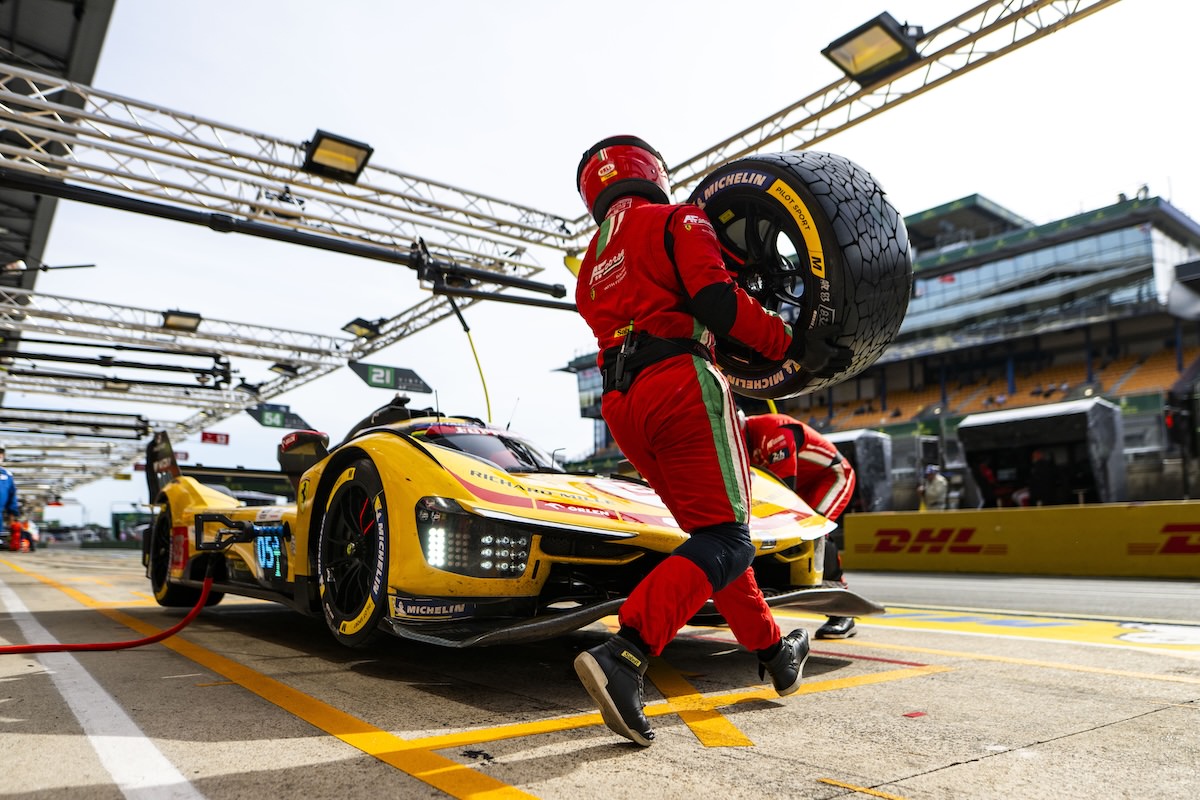
When the French manufacturer and its partners elected to postpone the introduction of a completely new tyre range from 2025 to 2026, the decision attracted little attention outside endurance racing circles. Internally, however, it reflected the scale of the challenge ahead.
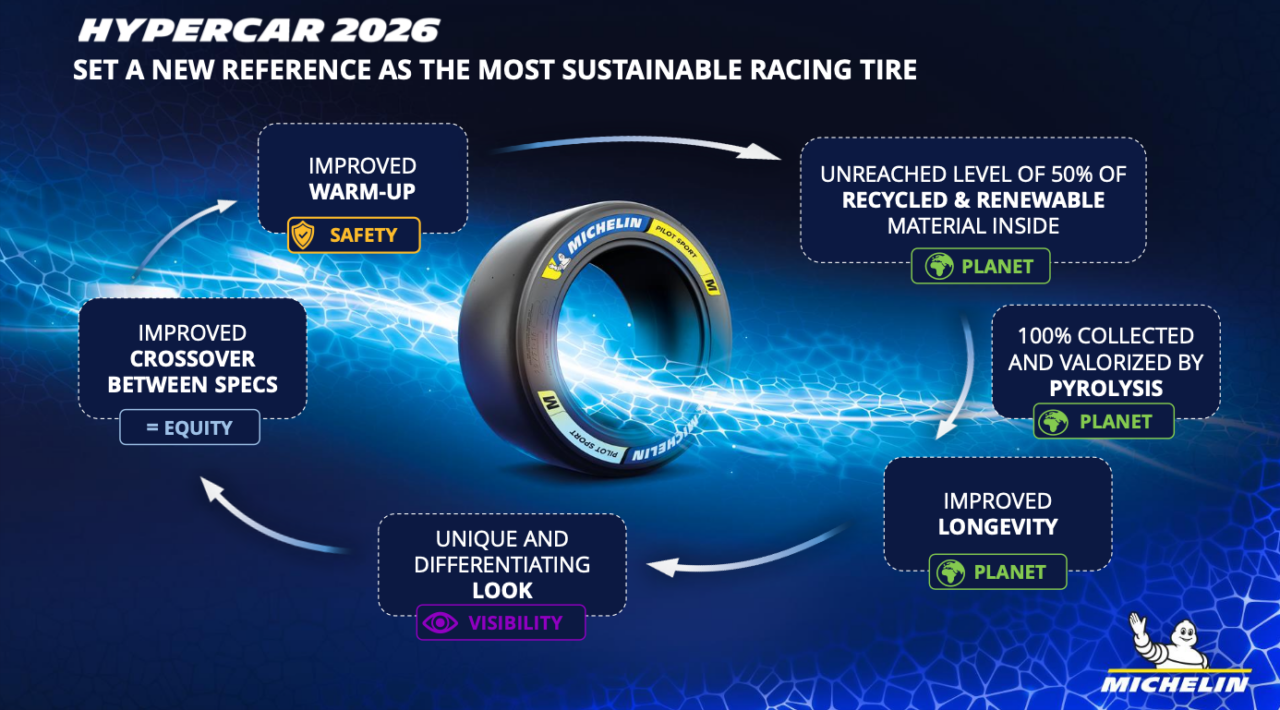
These tyres represent far more than a routine evolution. They have been conceived to improve fairness in a Balance of Performance environment, address the difficulties created by the ban on tyre warmers and support Michelin’s wider sustainability ambitions, all without sacrificing performance or longevity.
“It would be tempting to choose stability,” Michelin Motorsport director Matthieu Bonardel explained. “Since the arrival of Hypercar prototypes, the cars have gained around a second per lap every year by optimising tyre use.
“So why develop a new generation of tyres? Because it is precisely when everything is working well that you must dare to go further.”
The Interlagos lesson
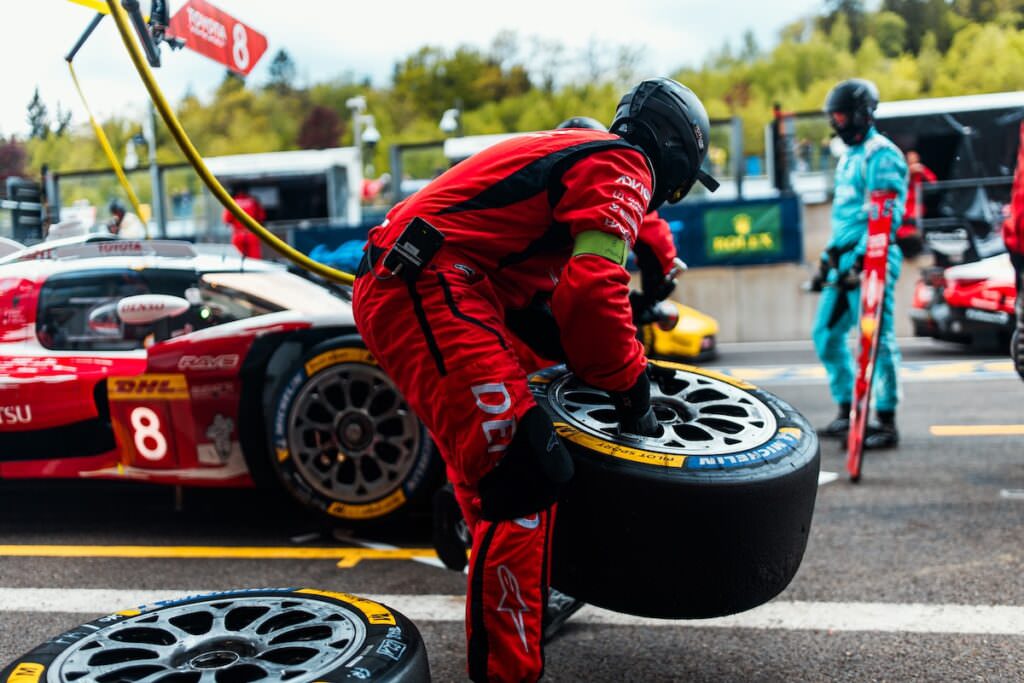
Part of the brief for Michelin’s new range came directly from events witnessed in competition. At Interlagos in 2024, Toyota emerged as the only manufacturer capable of exploiting medium tyres throughout the race distance. The strategic flexibility this offered translated into a clear competitive advantage over rivals that had to rely on harder compounds.
In a category governed by BoP, where tenths of a second are carefully managed, such differences can have a disproportionate impact.
“The promoter, due to BoP considerations, also asked for a smoother transition phase between different specifications,” Michelin Motorsport technical director Philippe Tramond explained.
The objective is straightforward: ensure sufficient overlap between compounds so that cars using different specifications can achieve equivalent performance under similar conditions. If track temperatures sit near the crossover point between mediums and hards, teams should no longer find themselves heavily penalised simply because one compound works for their car while another does not.
“Our objective is not to go faster,” Michelin endurance programme manager Pierre Alvès said. “That doesn’t make sense in a category governed by BoP. What we’re aiming for is fairness: tyres that work properly on every car and at every circuit.”
The discussion inevitably revives questions about Toyota’s historical advantage in tyre understanding. Some rivals have long argued that the Japanese manufacturer benefited from its uninterrupted presence in top-level endurance racing and from the fact that it was the only Hypercar competing when Michelin began gathering knowledge relevant to the current generation.
Whether that advantage stemmed from experience, operational excellence or continuity, Michelin’s latest project has been developed with the explicit aim of reducing such disparities.
Fixing the warm-up problem
The second major target concerns one of the defining characteristics of modern Hypercar racing: life without tyre warmers. Introduced in 2023 as part of the FIA and ACO’s environmental strategy, the ban fundamentally changed the opening laps of each stint. Drivers suddenly found themselves managing tyres that required considerable care before reaching their operating window.
“When you leave the pits you are on ice and just surviving,” Toyota driver Mike Conway memorably said at the time.
Several competitors struggled with the transition. Ferrari’s Antonio Fuoco lost a likely podium finish at Spa after being caught out on cold tyres, while teams voiced their concerns strongly enough that tyre warmers returned temporarily for the Le Mans 24 Hours. Le Mans ultimately remained the exception.
“The first area we targeted is warm-up, which is the weak point of the current range,” Alvès explained.
Improving that characteristic, however, is far from straightforward. Heat allows tyres to generate grip more quickly, but excessive temperatures accelerate degradation and compromise stint consistency.
“If the tyre wears faster, it loses consistency,” Alvès said. “So we had to find a compromise that improves warm-up, reduces wear and maintains stable performance.”
According to Michelin, the gains amount to several seconds over an outlap, approaching five seconds on a standard circuit.
Sustainability at racing scale
Environmental considerations formed another cornerstone of the project.
Michelin aims to incorporate an average of 40% renewable and recycled materials across all its products by 2030, before reaching 100% by 2050. Motorsport is expected to contribute to that transition.
“We launched a complete overhaul of our endurance range with a clear objective: incorporating 50% renewable and recycled materials while increasing overall performance,” Bonardel explained.
The challenge is particularly significant given the volumes involved. Michelin has previously demonstrated tyres containing 70% sustainable materials, while MotoE tyres already exceed the 50% threshold. Yet those projects involve limited production runs.
The Hypercar and GTP programmes require approximately 30,000 tyres annually.
“But sustainability doesn’t stop at renewable and recycled materials,” Tramond said. “It also concerns the entire lifecycle of the product.”
That philosophy has extended beyond manufacturing itself. Since early 2025, Michelin has worked alongside Swedish company Enviro on a WEC tyre recycling initiative based on pyrolysis technology.
Reinventing the recipe
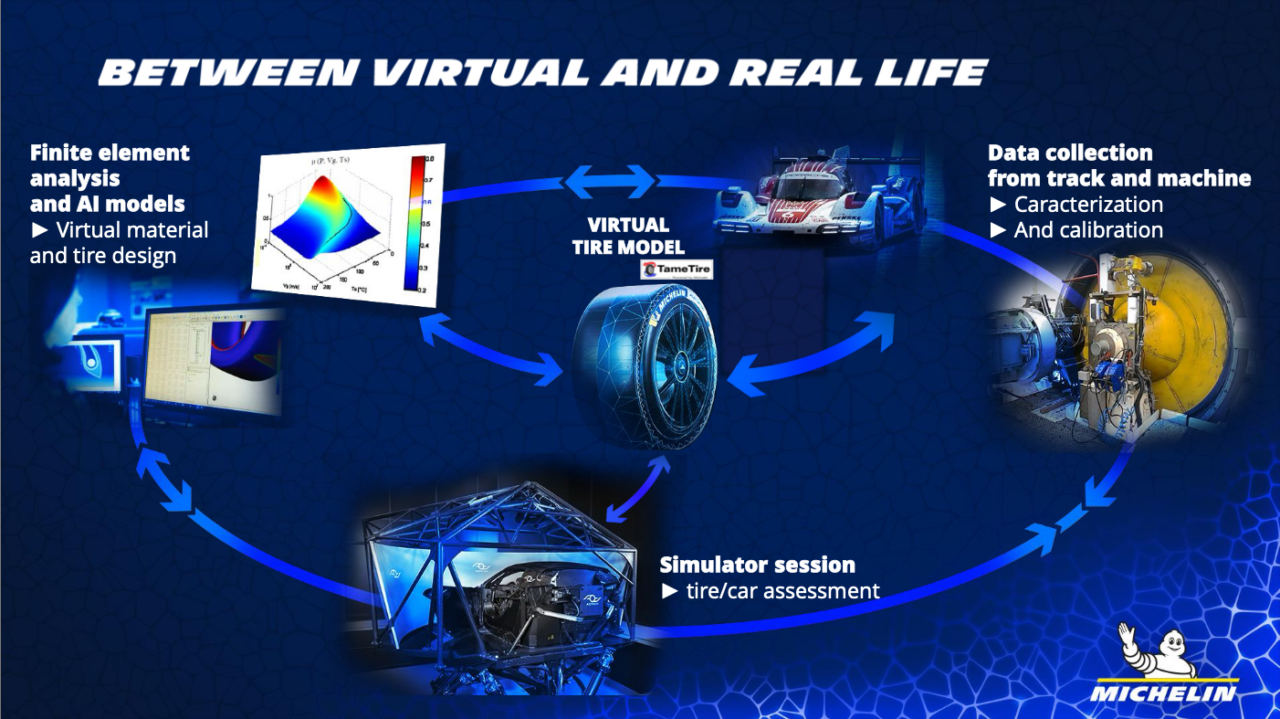
The complexity of the project explains why Michelin elected to delay its introduction by a year. Unlike the current generation — developed almost entirely through simulation for a still-emerging Hypercar class — the 2026 range relies on new materials and revised manufacturing processes, some of which had never previously been applied in racing tyres.
“If the ultimate objective is to match at least the current level of performance, then we have to change everything inside the tyre,” Tramond explained. “It’s like preparing a dish using completely different ingredients. You have to find the right recipe to make them work together.”
Development began in 2023 and followed a three-stage process. Simulation and virtual validation came first, leading to the creation of physical prototypes. These then underwent dynamic laboratory testing before progressing to track evaluations — the final arbiter in Michelin’s development philosophy.
Test sessions have been conducted at Portimão, Austin, Bahrain, Qatar, Sebring, Paul Ricard and Watkins Glen. The casing structure has already been homologated. Only compound optimisation remained under evaluation during the latter stages of the programme.
A new visual identity
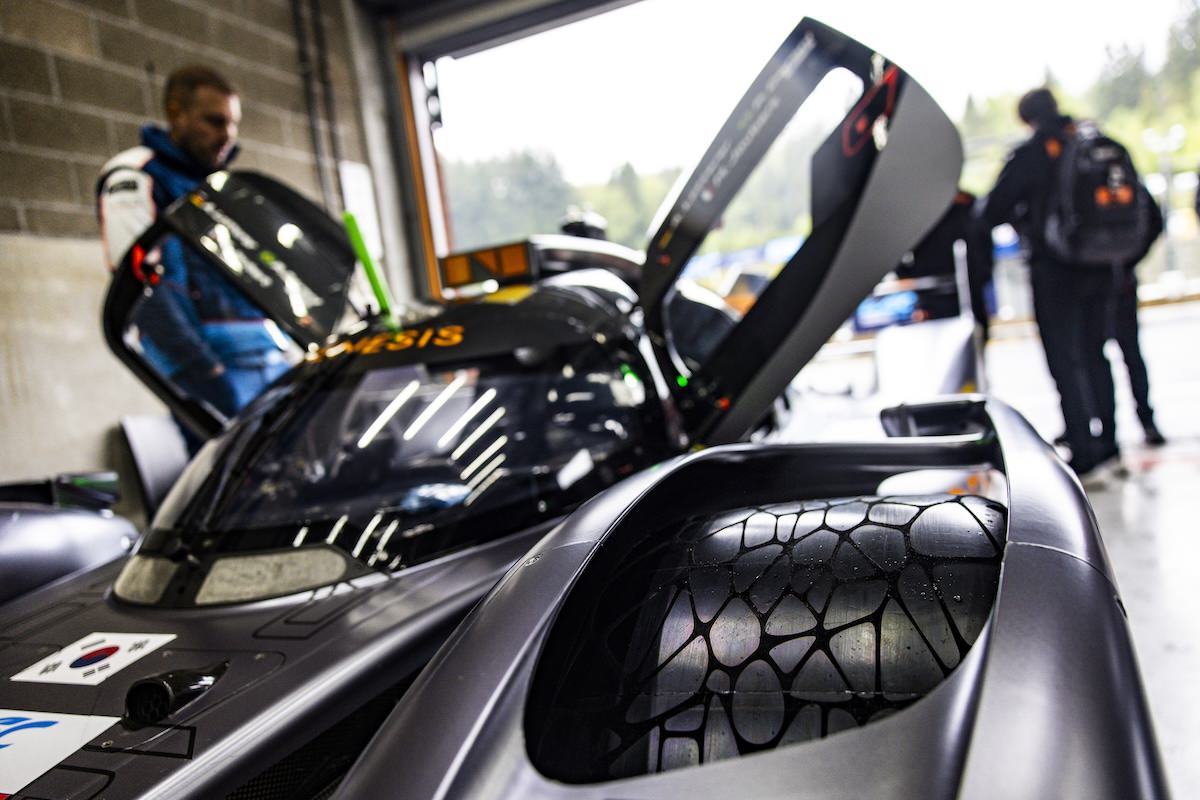
It also introduced a distinctive visual identity. Inspired by Michelin’s Vision concept and carrying a temporary velvet-effect surface treatment known as “Race to Vision”, the tyres feature a decorative layer that disappears after only a few corners.
“We asked ourselves how we could show that innovation was happening,” Alvès explained.
The answer lies beneath the surface as much as on it. The next generation of Hypercar tyres is not about rewriting the stopwatch.
Instead, Michelin has attempted something considerably more ambitious: creating a tyre capable of meeting the sporting, technical and environmental demands of endurance racing’s new era.