What future could Viry-Châtillon have without a Formula 1 engine programme and, soon, without a Hypercar project? The question had been hanging over the site for months. Renault Group has now provided an initial answer by agreeing to sell Alpine Racing SAS to Belgian powertrain specialist Dumarey.
Around 150 jobs are expected to be preserved. Once the transaction is completed, the company will operate under Dumarey’s brand, ownership and management. Financial terms have not been disclosed.
For Renault, the sale marks another step away from its historic engine-building activities. For Viry, it offers a way forward after two years in which the projects intended to support its transition struggled to provide enough work.
Half a century of Formula 1 history
The significance of this deal is difficult to appreciate without recalling what Viry-Châtillon once represented. Amédée Gordini moved his operation there in 1969, before the site became the home of Renault Sport’s engine activities. It would produce the engines behind almost half a century of Renault’s F1 history.
From the early turbocharged V6s to the dominant V10s of the 1990s and the V8s that powered Renault and Red Bull to championship success, generations of engineers helped build one of the sport’s most impressive records. Renault engines contributed to 12 constructors’ championships and 11 drivers’ titles.
That chapter closed at the end of 2025. On September 30, 2024, Renault confirmed the end of its works F1 engine programme, abandoning the power unit being developed for the new regulations. Alpine has used Mercedes power since the start of this season. Its chassis is still designed at Enstone, but Viry no longer develops its engine.
Hypertech could not fill the gap
The plan presented at the time was supposed to keep those skills within Renault Group. Renamed Hypertech Alpine, Viry was to work on the brand’s future supercar, batteries, electric motors and engineering services for external customers. Motorsport programmes were also intended to support the transition.
An F1 monitoring unit was announced, while every employee affected was to be offered a position within the new organisation.
But what work would keep the site’s roughly 300-350 employees occupied? The endurance programme could not do that alone. Its requirements were nowhere near those of a full F1 engine operation, particularly with the A424’s engine already designed and homologated. Nor could the Dacia Sandrider, built in the UK and powered by an engine produced in Japan, provide much additional work for Viry.
According to our information, BYD, Geely and Cadillac all visited the facilities. That does not mean each was considering an acquisition, but Viry’s equipment and expertise certainly attracted interest. It is ultimately Dumarey with which Renault Group has reached an agreement.
The A424 offered work, on a different scale
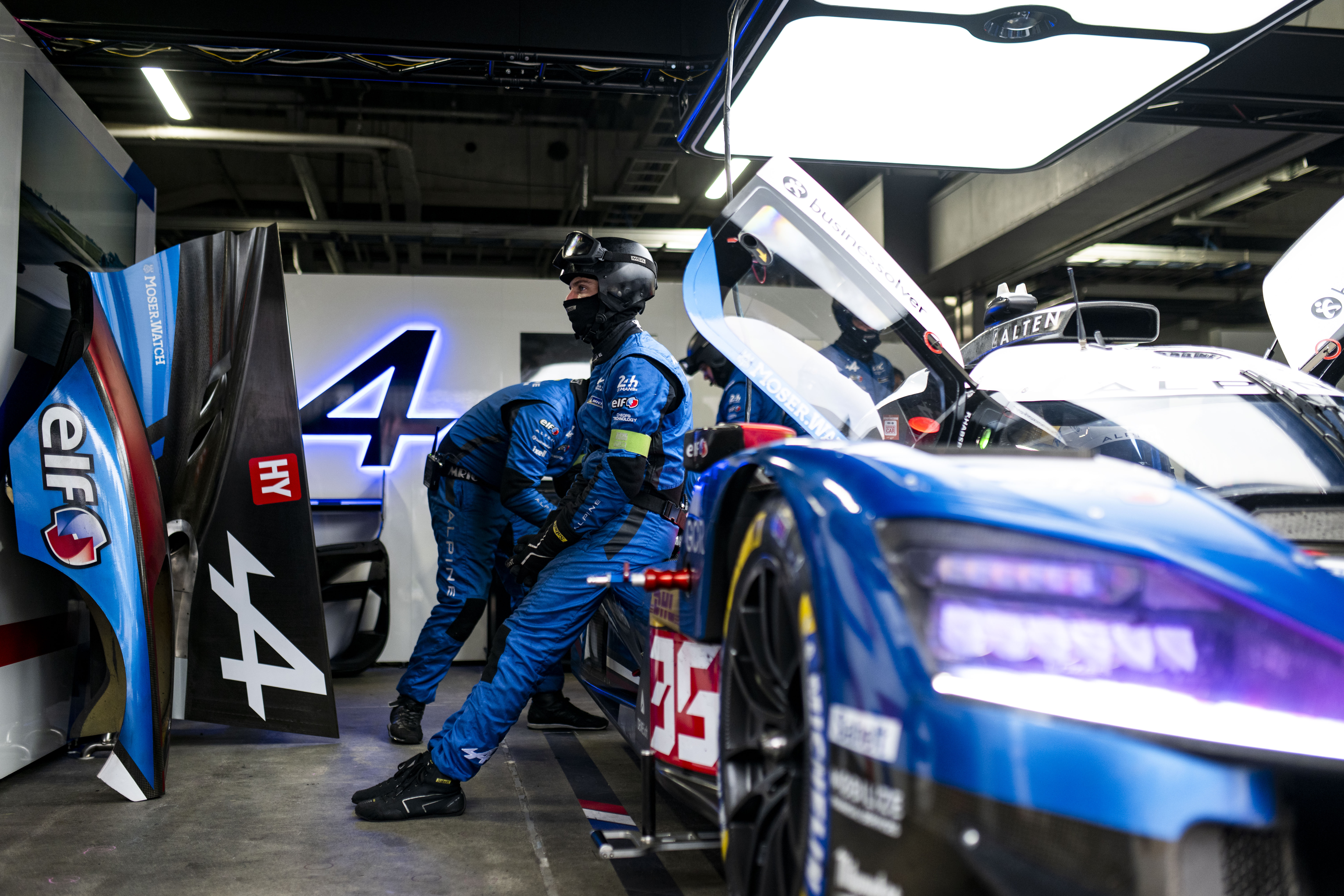
Viry had nevertheless strengthened its role in Alpine’s Hypercar programme. During the 2025 season, Alpine brought assembly of the A424’s turbocharged V6 in-house, taking over work previously carried out by Mecachrome.
Engine assembly, dyno testing and development work, particularly on reliability, were now handled internally. The reorganisation provided work for Viry’s staff while giving Alpine greater control over its engine programme. But it came as questions were beginning to emerge over the manufacturer’s own motorsport future.
The decision to end the Hypercar programme after 2026 subsequently undermined that activity too. And talks with Geely, which could have allowed the A424 to continue under a different identity, did not lead to an agreement, as we revealed.
The sale of Alpine Racing SAS does not, in itself, amount to a takeover of the A424 programme. Nothing announced so far indicates that Dumarey’s arrival changes the situation for the Hypercar or Signatech, which runs the cars.
What engines will Viry work on next?
Previously known as Punch, Dumarey is a Belgian family-owned group specialising in powertrain development and production. Engines, transmissions and energy recovery are among its activities, offering several potential uses for Viry’s facilities. The group acquired ZF’s Bouthéon operation in 2023.
Through Dumarey Green Power, it also owns flywheel energy storage technology originally developed for Formula 1 and subsequently adapted for industrial applications.
At Viry, the companies have raised the possibility of making the site’s engine expertise available to racing teams. No customer or specific programme has yet been announced.
Dumarey is therefore taking over an operation with considerable facilities and specialist skills, but one from which Renault has progressively withdrawn its programmes. Preserving around 150 jobs provides an initial answer to employees’ concerns. The next task is to secure the contracts that will sustain them.