Over the past few years, the Automobile Club de l’Ouest has steadily reshaped the format in an effort to make the fight for pole position more compelling, both for competitors and spectators. The introduction of Hyperpole in 2020 marked the beginning of that evolution. Two years ago, the concept was expanded further when Hyperpole itself was split into two separate sessions.
Now, for 2026, another subtle but significant adjustment has been made.
At first glance, it appears to concern little more than driver allocation. In reality, it reinforces a principle that has always sat at the heart of endurance racing: success depends on the entire crew, not just the fastest driver.
Three sessions, two evenings, one pole position
The battle for pole position unfolds across two days.
Proceedings begin on Wednesday, June 10, with the initial Qualifying sessions. LMP2 and LMGT3 take to the track at 18:45 local time, before Hypercar follows at 19:30.
The objective is straightforward. Finish among the 15 fastest cars in your category and the adventure continues. Miss the cut and your grid position is effectively decided.
Those 15 survivors advance to Hyperpole 1, which takes place on Thursday evening.
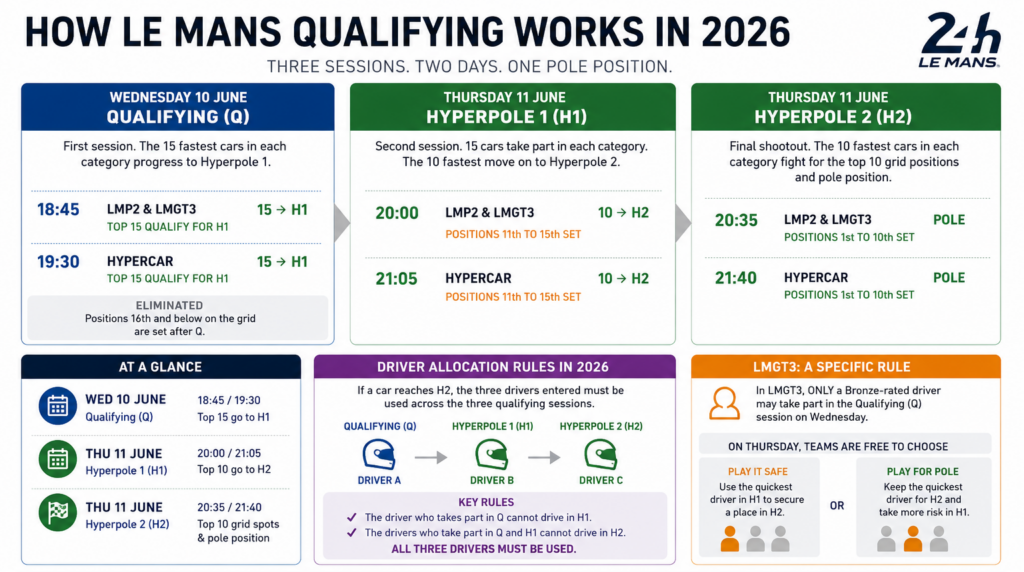
LMGT3 and LMP2 open proceedings at 20:00, with Hypercar following at 21:05. Once again, the field is reduced, this time from 15 cars to 10. The crews eliminated at this stage secure positions 11th to 15th on the grid.
The remaining contenders move on to Hyperpole 2.
Scheduled for 20:35 for LMGT3 and LMP2, and 21:40 for Hypercar, H2 is where the first 10 positions on the grid are decided and where pole position is ultimately settled.
The structure is easy enough to understand. Executing it is another matter entirely.
The rule change everyone will be watching
The most important change for 2026 concerns the drivers entrusted with those laps.
Last year, regulations already stipulated that the driver competing in Hyperpole 2 had to be different from the one who had taken part in Hyperpole 1. For this year’s event, the ACO has gone a step further.
The driver who participates in Wednesday’s Qualifying session is no longer permitted to drive in Hyperpole 1. Likewise, the drivers used in Qualifying and Hyperpole 1 are both ineligible for Hyperpole 2.
The consequence is simple.
Should a car reach the final Hyperpole 2 shootout, all three drivers in the crew must have participated somewhere during the qualifying process.
One driver tackles Qualifying. A second is tasked with progressing through H1. A third is left to fight for pole position in H2.
What may appear to be a minor regulatory tweak fundamentally changes the way teams approach qualifying week.
Rather than building their strategy around a single qualifying specialist, crews must now consider the strengths and weaknesses of their entire line-up. The challenge is no longer merely to identify the fastest driver. It is to determine the most effective sequence.
In that sense, the format feels increasingly aligned with the essence of endurance racing itself.
“Having to change drivers complicates things,” explained Sebastien Buemi. “It means the three drivers need to prepare for flying laps, and that takes up more time in free practice. Given how little grid position affects the race result at Le Mans, I’m not sure it’s necessary.”
Why Pro/Am classes remains a unique challenge
One important exception remains within LMGT3 et LMP2 categories.
As in previous years, in LMGT3, only a Bronze-rated driver is allowed to take part in Wednesday’s Qualifying session.
In LMP2, qualifying duties are assigned to the driver with the lowest FIA driver rating: the Bronze-rated driver in LMP2 Pro/Am entries, and the Silver-rated driver in standard LMP2 entries.
Yet it also introduces another layer of strategy. Once Thursday arrives, teams are free to choose how they deploy their remaining drivers.
Last year, some LMGT3 crews effectively treated Hyperpole 1 as the key session, sending out their fastest professional driver in an effort to guarantee progression into the final shootout. Others preferred to keep their ace in reserve, accepting a greater degree of risk in H1 in exchange for a stronger chance of securing pole position in H2.
Neither approach offered any guarantees. Both carried risks. And that uncertainty is precisely what makes the category so fascinating to follow.
When Le Mans rewrote the grid
Curiously, the new qualifying format brings Le Mans full circle.
Back in 1980, pole position was not awarded to the driver who set the outright fastest lap, but to the crew that achieved the best average time across all of its drivers. John Fitzpatrick may have been the fastest man around La Sarthe in Dick Barbour Racing’s Porsche 935, yet the car lined up only second on the grid. Pole instead went to the Rondeau M379B shared by Henri Pescarolo and Jean Ragnotti.
In truth, Le Mans has rarely been afraid to experiment with its grid procedures.
From 1923 until 1962, starting positions (and numbers) were determined by engine capacity. Since 1963, pole position has generally belonged to the car whose driver recorded the fastest qualifying lap. But there have been notable exceptions.
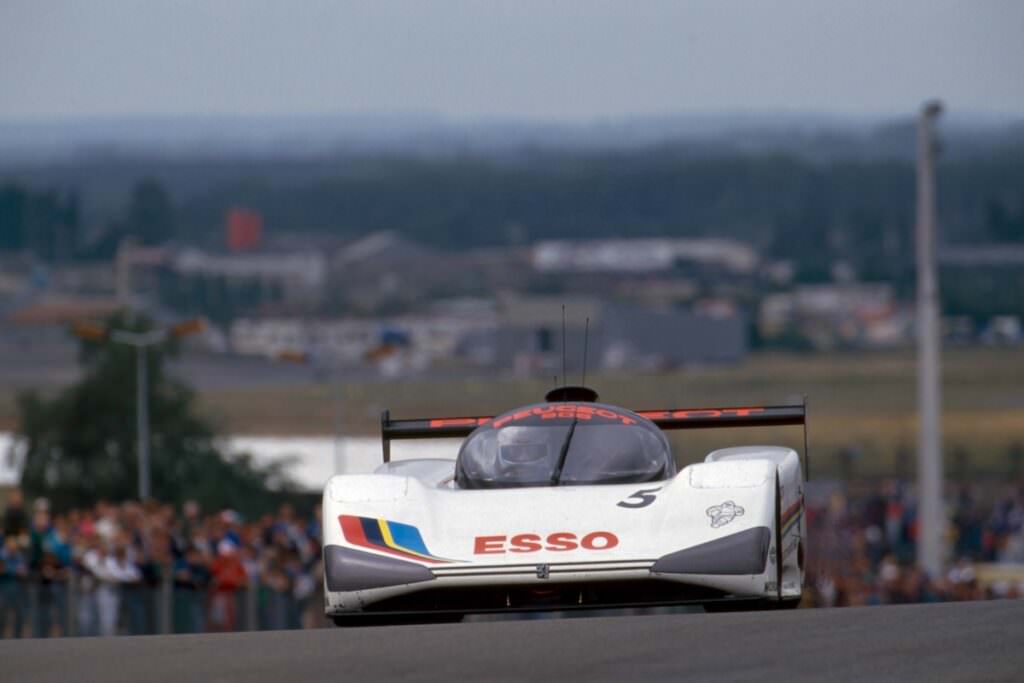
The first was that 1980 edition. The second came in 1991, when organisers reserved the front rows for naturally aspirated 3.5-litre prototypes built to the new World Sportscar Championship regulations. As a result, Jean-Louis Schlesser, despite setting the fastest qualifying time in his turbocharged Sauber-Mercedes, found himself relegated to the sixth row of the grid. Ahead of him were the 10 WSC entries, headed by the #5 Peugeot 905 ⬆️ crew of Philippe Alliot, Mauro Baldi and Jean-Pierre Jabouille.
Le Mans has occasionally embraced other unconventional solutions. In both 1996 and 1997, for instance, prototypes occupied the left-hand side of the grid while GT cars lined up on the right.
The modern era has brought further changes. Since 2020, the starting order has first been determined by category and then by laptime, with Hypercars placed ahead of LMP2 cars and GT entries. That same year also marked the arrival of Hyperpole.