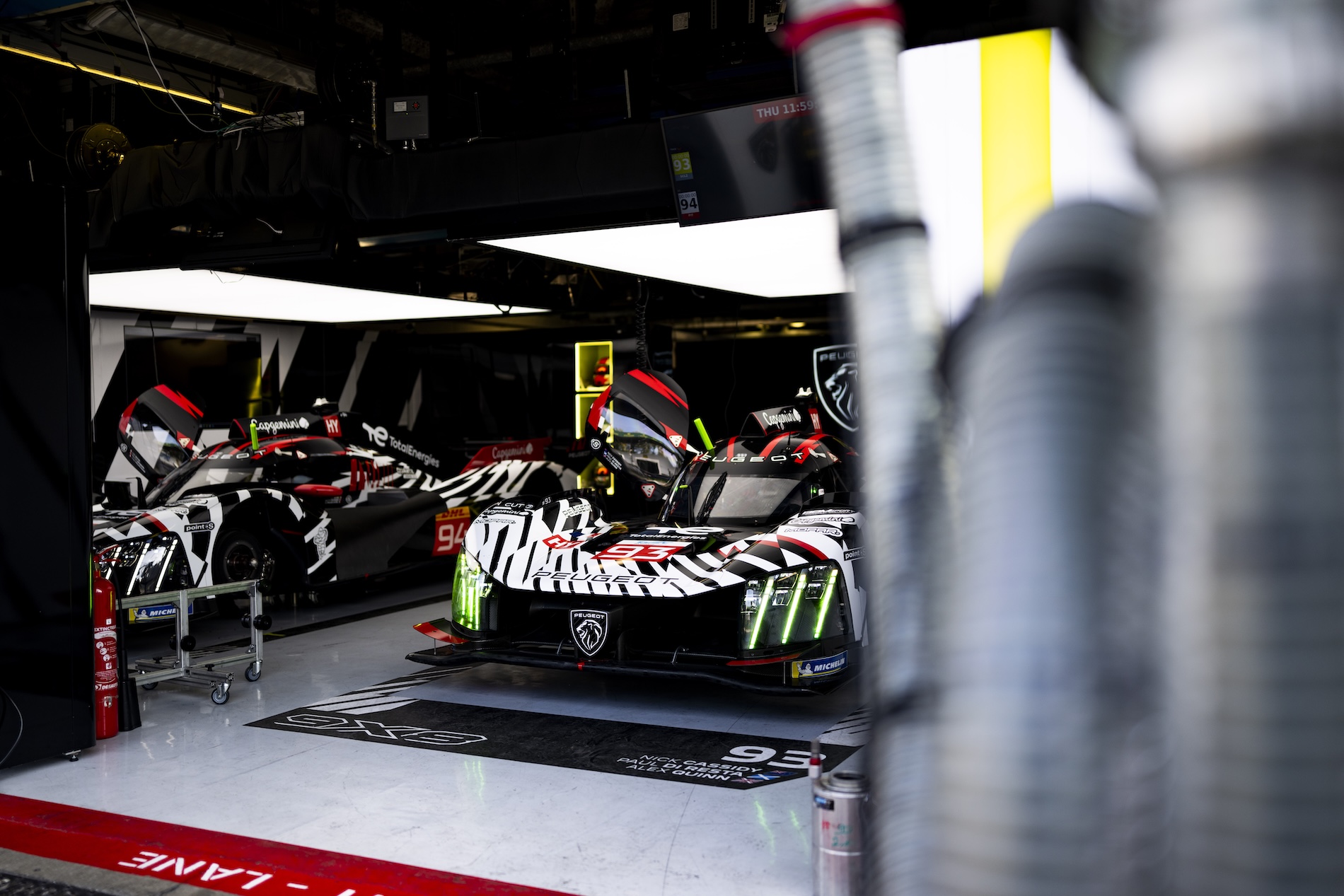
Could history be about to repeat itself? Fourteen years after withdrawing from endurance racing in January 2012, on the eve of the FIA WEC’s inaugural season, Peugeot could once again bring its involvement in the discipline to an end. According to our information, the future of the French manufacturer’s Hypercar programme is now under serious threat, with an announcement potentially coming in the next few days.
Contacted by The Stint, Peugeot confirmed that extraordinary meetings of the employee representative bodies (CSE/CSEC) have been called to discuss matters with Stellantis Motorsport employee representatives. However, the manufacturer declined to disclose the topics to be addressed, citing the need to respect the employee information and consultation process.
At this stage, no official decision to terminate the programme has been announced, and we are not in a position to establish the reasons behind the situation. Nevertheless, the prospect of another withdrawal inevitably brings back memories of January 2012, when Peugeot abruptly ended a highly successful endurance racing programme.
There are, however, important differences between the two situations. Back then, the French manufacturer was leaving endurance racing as one of its leading forces. This time, a far more challenging chapter could be drawing to a close. Competing in the WEC since July 2022, the Peugeot 9X8 has yet to claim a single victory, despite several technical developments and occasional encouraging performances.
The 9X8: A Bold Technical Gamble That Never Truly Paid Off
When Peugeot unveiled the 9X8 in 2021, it chose to pursue a radically different approach. Its new Hypercar stood out for its lack of a rear wing, an unconventional aerodynamic concept made possible by the LMH regulations.
The car attracted as much curiosity as admiration. Peugeot wanted to demonstrate that a different technical philosophy could deliver the same level of performance as its rivals.
The 9X8 made its competitive debut at the 6 Hours of Monza in July 2022. But the reality of racing soon proved more difficult than anticipated. Its first podium came a year later, again at Monza, when the No. 93 finished third. It was an encouraging result, but one that did little to conceal the limitations of the original concept, despite the developments introduced to the car.
Peugeot subsequently decided to undertake a substantial redesign. In 2024, a revised version of the 9X8 made its debut at Imola, now featuring a rear wing and different tyre dimensions at the front and rear. Around 90% of its bodywork had been redesigned.
The update reflected both the scale of the work undertaken and the difficulties associated with the original technical choices. Yet the improvements still failed to deliver a victory, even if the 2025 season brought some welcome results. At Austin, Peugeot returned to the podium with a third-place finish. Two weeks later, the No. 93 finished second in the 6 Hours of Fuji, having led the race for a significant period. It was the 9X8’s best result since its competitive debut.
Those performances, however, remained isolated. They neither produced a maiden victory nor established Peugeot as a consistent contender at the front of the field.
The contrast with the manufacturer’s previous endurance racing campaign is striking. While the 908 had accumulated victories and challenged Audi for supremacy, the 9X8 has never managed to establish itself as a regular contender for race wins.
Decisions That Go Beyond Peugeot
One important point should not be overlooked: decisions concerning Peugeot’s motorsport involvement are not necessarily made by the brand alone. They would form part of broader strategic considerations at Stellantis group level.
That raises another question: could the group’s Formula E programmes also come under threat? It is a possibility that cannot be ruled out, although we currently have no information suggesting that those programmes are themselves facing an imminent decision.
The comparison with 2012 is particularly relevant in this respect. At the time, Peugeot abruptly terminated its endurance racing programme for economic reasons, despite having one of the most competitive prototypes on the grid. There is, however, nothing to suggest that the motivations behind the current situation would be the same.
Should another withdrawal be confirmed, it would bring an end to a campaign that, despite the resources committed and the successive developments of the 9X8, has never allowed the French manufacturer to return to winning ways in endurance racing.
2012: The Memory of a Sudden Withdrawal
On 18 January 2012, Peugeot announced the immediate termination of its endurance racing programme. The news sent shockwaves through the paddock. The French manufacturer had been due to compete in the inaugural FIA World Endurance Championship, a series whose creation it had actively supported, and continue its rivalry with Audi.
But PSA’s management had other priorities. Faced with a difficult economic environment and a busy schedule of commercial vehicle launches, the group decided to concentrate its resources on its core automotive business.
The decision was all the more striking given Peugeot’s recent success. Having won the 24 Hours of Le Mans in 2009, the manufacturer had also claimed both editions of the Intercontinental Le Mans Cup in 2010 and 2011. Its recent record was remarkable: fourteen victories in its final sixteen races.
Peugeot was therefore not leaving endurance racing because of poor results. It was walking away from an exceptionally successful sporting programme just as the WEC was preparing to begin its first season.
A hybrid version of the 908 had even been developed, but never had the opportunity to demonstrate its potential in competition. A similar scenario could now unfold with the 2027-specification 9X8, which has been accumulating test mileage since last summer but could likewise never make its racing debut.
Fourteen years later, the prospect of another Peugeot withdrawal has resurfaced. This time, however, the French manufacturer would not be leaving behind a dominant racing car.